Dubai Food Guide: Best Restaurants, Street Food & Cafes
Dubai is no longer just a destination for shopping and skyscrapers. In 2026, it has officially become one of the greatest food cities on earth. Tripadvisor’s 2026 Travelers’ Choice Awards ranked Dubai as the world’s second-best food destination, behind only London and ahead of Rome, Paris, and Hong Kong. With over 13,000 licensed restaurants serving cuisines from more than 200 nationalities, an average of three new restaurants opening every single day, and a Michelin Guide that has grown to approximately 20 starred establishments, Dubai’s food scene in 2026 is genuinely extraordinary.
This Dubai food guide covers everything a visitor needs to know before eating in the city — from the traditional Emirati dishes you cannot leave without trying, to the best street food areas, the famous Dubai Friday brunch culture, halal food etiquette, budget eating tips, and a realistic price guide across every level of dining. Whether you are visiting Dubai for the first time or returning to explore its evolving restaurant scene, this Dubai food guide gives you the complete picture.
Why Dubai Is One of the World’s Great Food Cities
Understanding what makes Dubai’s food scene exceptional requires understanding the city itself. Dubai is home to a population where over 90 percent are expatriates from more than 200 nationalities, and this multicultural reality has created a food landscape of extraordinary variety. Indian, Pakistani, Filipino, Lebanese, Iranian, Ethiopian, Chinese, Japanese, Italian, Turkish, and Emirati cuisines all coexist at every price point in the city.What distinguishes Dubai from other multicultural food cities is the combination of this variety with genuine quality at all levels. A AED 8 shawarma from a Deira street stall is prepared with the same care and quality ingredients as a AED 2,000 omakase tasting menu at a Palm Jumeirah restaurant. The standards across the board are high because competition is intense and consumers are discerning.
The arrival of the Michelin Guide in Dubai in 2022 transformed the city’s restaurant industry further. Restaurants that received stars saw booking increases of 200 to 400 percent. As of 2026, Dubai has approximately 20 Michelin-starred restaurants, including two two-star establishments. Trèsind Studio holds the distinction of being the world’s only three-star Indian restaurant and one of just two Middle East entries on The World’s 50 Best Restaurants list. This is the context within which Dubai’s Dubai food guide sits in 2026 — a food city that has arrived at the highest global level.
Traditional Emirati Food: What to Eat First
No Dubai food guide is complete without covering traditional Emirati cuisine, and yet this is the category most consistently underrepresented in mainstream guides that focus on international restaurants. Emirati food is the soul of the city’s culinary heritage and deserves to be the starting point of any serious food visitor’s itinerary.
Al Machboos — The National Dish
Al Machboos, also known as Kabsa, is widely considered the national dish of the UAE and the most important entry in any Dubai food guide covering Emirati cuisine. It is a fragrant spiced rice dish slow-cooked with meat, fish, or chicken and seasoned with loomi (dried lime), saffron, and a distinctive Gulf spice blend called bzar that gives it a flavour profile unlike any Indian, Arabic, or Persian rice dish you will have encountered elsewhere. The best version uses bone-in lamb and cooks for several hours until the meat falls away and the rice absorbs all the cooking juices. Al Machboos costs between AED 35 and AED 55 at most traditional Emirati restaurants. Try it at Arabian Tea House in Al Fahidi or Al Reef Bakery for a genuinely authentic experience.
Al Harees — Ancient Simplicity
Al Harees is one of the oldest dishes in the Gulf and a strong contender alongside Machboos for the title of most important Emirati dish. Made from just two ingredients — wheat and meat — slow-cooked together for hours in a clay pot until they become a smooth, porridge-like consistency, it is a dish that initially surprises visitors with its simplicity but rewards those who give it proper attention. The version served at major Emirati restaurants during Ramadan and traditional celebrations is the best way to experience it. It is available year-round at established Emirati dining venues.
Luqaimat — Traditional Sweet Dumplings
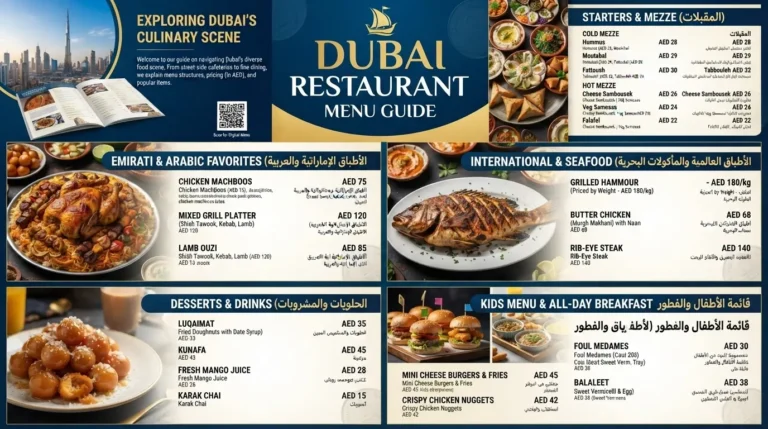
Luqaimat are small golden dumplings deep-fried until crispy on the outside and pillowy within, then drizzled with dark date syrup and dusted with sesame seeds. They are Dubai’s most beloved traditional street sweet and are sold from dedicated Luqaimat carts throughout the city at prices of AED 10 to AED 20 per portion. The cart outside the Dubai Museum in Al Fahidi serves what many long-term residents consider the best Luqaimat in the city. These are the first thing a Dubai food guide should direct any visitor toward for a genuine taste of Emirati sweet culture.
Balaleet — Emirati Breakfast
Balaleet is one of the most distinctive Emirati breakfast dishes and one of the most unexpected — sweet vermicelli noodles flavoured with cardamom, saffron, and rosewater, served alongside or topped with a thin omelette. The combination of sweet and savoury in a breakfast context feels unusual to most Western visitors but is deeply satisfying and genuinely unique. Arabian Tea House in Al Fahidi serves the most celebrated version in the city and is the single most important Emirati restaurant recommendation in this Dubai food guide.
Gahwa — Arabic Coffee
No Dubai food guide can discuss Emirati food culture without dedicating space to gahwa, the traditional Arabic coffee served in small handle-less cups alongside dates. Gahwa is made from lightly roasted green coffee beans flavoured with cardamom and sometimes saffron, and has a pale golden colour and a flavour entirely unlike the dark espresso-based coffees that dominate global cafe culture. Refusing gahwa when offered is considered mildly impolite in Emirati culture. Accepting a cup and eating a date with it is one of the small rituals that connects visitors to the genuine hospitality culture of the UAE.
Best Street Food in Dubai 2026
Dubai’s street food scene is one of the most overlooked aspects of the city’s food culture and one of the most important sections of this Dubai food guide for budget-conscious visitors. The best street food in Dubai is genuinely world-class by any standard and costs almost nothing.
Shawarma — Dubai’s Most Iconic Street Food
When locals talk about Dubai street food, shawarma is always the first dish mentioned, and this Dubai food guide agrees with their judgement. Shawarma consists of marinated chicken or meat slow-roasted on a vertical spit, then sliced and served in warm bread with tahini sauce, garlic paste, pickled vegetables, and fresh tomatoes. The quality difference between a great Dubai shawarma and an average one comes down entirely to the marinade and the freshness of the bread. Al Dhiyafah Road in Al Satwa, the Al Karama area, and the small eateries around Deira’s Textile Souk are the most celebrated shawarma areas in the city. Al Mallah on 2nd December Street is the single most recommended shawarma spot in Dubai among long-term residents and food writers alike. Prices range from AED 8 to AED 15 per piece.
Falafel and Hummus
Falafel in Dubai is typically Lebanese-style — crispy, herb-filled balls of ground chickpeas or fava beans served with tahini sauce, fresh salad, and warm flatbread. Dubai’s Lebanese population has brought an exceptionally high standard of falafel to the city, and the best versions found in the Lebanese and Syrian restaurants of Deira and Karama rival anything available in Beirut. Hummus quality in Dubai is similarly high — the best has the almost impossibly smooth texture achieved through patient blending that is a hallmark of the Lebanese cooking tradition. A falafel wrap costs AED 5 to AED 12 at street-facing shops throughout the city.
Manakish — The Lebanese Flatbread
Manakish is a Lebanese flatbread topped with za’atar herb paste, cheese, or a combination of both and baked fresh in a wood or gas-fired oven. It is one of the most satisfying and affordable breakfasts or snack options in Dubai’s food scene. Fresh manakish bakeries are particularly concentrated in the Karama and Al Satwa neighbourhoods and open from early morning. A za’atar manakish costs AED 5 to AED 8 and constitutes a complete light meal.
Knafeh — Arabic Dessert Excellence
Knafeh is the quintessential Arab dessert and one of the most important dessert experiences in this Dubai food guide. Warm shredded pastry layered with white cheese, soaked in rose-flavoured sugar syrup, and topped with crushed pistachios, it is best eaten fresh and hot from a traditional Arabic sweets shop. The Dubai Chocolate phenomenon that began in 2024 and accelerated through 2025 actually incorporates knafeh filling — the Dubai Chocolate bar that became a global viral sensation uses a filling of pistachio cream and butter-fried kunafa pastry. The original and still the best version is the traditional knafeh served from Syrian and Lebanese sweets shops throughout Deira, available for AED 15 to AED 25 per portion.
Best Areas for Eating in Dubai by Neighbourhood
This section of the Dubai food guide organises the city’s best eating areas geographically, which is how most visitors actually plan their meals.
Deira — The Budget Food Capital
Deira is the most affordable and arguably the most rewarding area for eating in the entire city. As the oldest commercial district in Dubai, it has the highest density of budget restaurants, the most authentic South Asian and Middle Eastern food options, and the least tourist-oriented dining environment of any area in the city.
Ravi Restaurant in nearby Satwa has served Pakistani cuisine since the 1970s and is the single most consistently recommended budget restaurant in every Dubai food guide worth reading. The menu covers seekh kebabs, chicken karahi, daal, biryani, and naan. A full meal costs AED 25 to AED 40. Al Ustad Special Kebab, operating since 1978, is another institution in this category with particularly celebrated kebabs. Meena Bazaar in Bur Dubai, adjacent to Deira, has a food street lined with Indian and Pakistani restaurants serving thali meals from AED 15 and biryani from AED 18. This is the single best value eating area in Dubai.
Al Fahidi and Al Seef — Heritage Dining
The Al Fahidi Historical Neighbourhood and the adjacent Al Seef waterfront development offer a completely different dining atmosphere from the rest of the city. Arabian Tea House in Al Fahidi is the most celebrated traditional Emirati restaurant in Dubai and serves the full range of Emirati breakfast dishes alongside its famous cream chai and date spreads. The setting — a restored courtyard building in the most atmospheric neighbourhood in Old Dubai — makes it the most complete dining experience for visitors wanting both Emirati food and authentic surroundings. Sikka Cafe, hidden in the alleys of Al Fahidi, serves traditional gahwa, luqaimat, and light Emirati dishes in one of the most intimate settings in the city.
Downtown Dubai and DIFC — Fine Dining Central
Downtown Dubai and the adjacent DIFC financial district represent the heart of Dubai’s premium and fine dining scene. Row on 45, the 12-seat haute cuisine experience from British chef Jason Atherton, is one of the most talked-about new restaurants in the city. Zuma in DIFC is the most consistently celebrated Japanese restaurant in Dubai and serves one of the most sought-after Saturday brunches in the city. The restaurant density and quality in this corridor is among the highest in the Middle East.
Dubai Marina and JBR — Waterfront International Dining
Dubai Marina and the adjacent JBR strip offer the most visible and tourist-accessible international dining in the city. The waterfront setting along the marina promenade hosts a broad range of international restaurants at mid to upper-mid price points. The Beach at JBR has a strong mix of casual international dining with sea views. This area is best for visitors wanting a pleasant waterfront dining experience with international cuisine rather than for those seeking the most authentic or most adventurous food options in the Dubai food guide.
Palm Jumeirah — Luxury and Experiential Dining
Palm Jumeirah is home to some of Dubai’s most spectacular dining experiences. Ossiano at Atlantis The Palm is the most famous of these — an underwater restaurant where diners eat surrounded by the giant aquarium of Atlantis, and one of the highest-rated fine dining restaurants in the city. Nobu One Za’abeel, the latest addition to the Nobu group’s Dubai portfolio, serves signature Japanese-Peruvian dishes 230 metres above the city at One Za’abeel tower. Carbone at Atlantis The Royal brings 1950s New York Italian-American glamour and tableside theatrics to the Palm’s luxury resort strip. These are not budget options — they represent the pinnacle of Dubai’s experiential dining scene.
The Dubai Friday Brunch — A City Institution
No Dubai food guide is complete without a full explanation of the Friday brunch culture, which is one of the most distinctive and important aspects of eating in Dubai and something that has no real equivalent anywhere else in the world.
The Dubai Friday brunch is a three to four hour unlimited food and beverage experience served at most major hotel restaurants every Friday. It evolved from the UAE’s adoption of Friday as the weekend day and has become one of the city’s defining social rituals. Thousands of Dubai residents and visitors gather at brunch venues across the city every Friday between noon and 4pm, and the best brunches require booking weeks in advance.
For a non-alcoholic brunch, the options across Dubai are extensive. The Grand Brunch at Atlantis, Bubbalicious at the Westin Mina Seyahi, and the Friday brunch at Shangri-La are consistently cited as the most celebrated options at the upper end. Prices range from AED 250 to AED 500 per person for food-only brunches. Zuma’s Saturday brunch is similarly celebrated — Japanese sharing dishes flow endlessly including robata meats, sushi platters, tempura, and wagyu in one of the city’s most stylish environments, making it worth its AED 500-plus price point for a special occasion.
Halal Food in Dubai: What Visitors Need to Know
Halal food is not a speciality category in Dubai — it is the default. Dubai is a fully halal city where virtually all restaurants serve halal food as a matter of law and regulation. The Dubai Municipality’s halal certification system covers the entire food service industry, and ESMA (Emirates Authority for Standardization and Metrology) oversees halal standards nationally.
For Muslim visitors, this means the food guide for Dubai is straightforward — the vast majority of restaurants require no verification of halal status beyond confirming that the establishment serves alcohol, which some do. Pork products are not widely available at mainstream restaurants and when present are clearly marked on menus and served in dedicated sections. Many major hotel restaurants carry a small pork section for Western guests, which is clearly segregated.For non-Muslim visitors, understanding that virtually all meat served in Dubai is halal-certified is simply good food knowledge. The halal slaughter process affects freshness more than flavour, and the quality of meat served in Dubai’s restaurants is high by international standards.
Budget Eating in Dubai: Best Cheap Eats 2026
One of the most persistent misconceptions about eating in Dubai is that it is uniformly expensive. This Dubai food guide addresses that misconception directly. The city covers every price point from AED 5 street snacks to AED 500 tasting menus.The most affordable and some of the most delicious food in Dubai is found in Deira, Bur Dubai, Al Karama, and Al Satwa. Ravi Restaurant serves the most celebrated cheap meals in the city — full Pakistani dinner with bread and drink for AED 35. Meena Bazaar food street serves thali meals from AED 15 and fresh juice from AED 5. Shawarma from any good street-facing shop costs AED 8 to AED 15. Falafel wraps cost AED 5 to AED 12.
For slightly more comfortable but still very affordable dining, mall food courts at Ibn Battuta Mall and City Centre Deira offer the best value among major malls, with full meals from Indian and Desi food counters available for AED 20 to AED 30. Supermarket food halls at Carrefour and Spinneys sell prepared hot meals, fresh sandwiches, and salads for AED 15 to AED 25, making them a practical option for visitors managing daily food costs carefully.The principle this Dubai food guide operates on is simple — eating cheaply in Dubai does not mean eating badly. Some of the most memorable food experiences in the city cost under AED 30.
Dubai Michelin Guide 2026: What You Need to Know
The Michelin Guide Dubai 2025 listed 19 starred restaurants, including three three-star establishments, making Dubai one of the most significant Michelin destinations in the Middle East. For 2026, approximately 20 starred restaurants are listed, with the guide continuing to expand its coverage.Trèsind Studio is the undisputed jewel of the Dubai Michelin scene — the world’s only three-star Indian restaurant and the highest-reviewed Michelin-starred venue on Tripadvisor in Dubai, with a 4.5 out of 5 rating from approximately 2,000 reviews. The progressive Indian cuisine served here represents a category of cooking that exists nowhere else in the world at this level.Four new venues received Bib Gourmand distinctions in 2026 — Berenjak Al Maha, Fenyal, Mila, and Baron — taking the total to eight and providing an accessible entry point into Dubai’s celebrated restaurant scene for visitors without the budget for full Michelin starred dining. Bib Gourmand establishments in Dubai offer exceptional food at accessible prices, typically AED 100 to AED 200 per person.
Practical Food Tips for Visiting Dubai 2026
Best Times to Eat
Lunch in Dubai is served from noon to 3pm and is often significantly cheaper than the same dishes at dinner. Many restaurants, particularly in the mid-range category, offer business lunch specials at 20 to 40 percent below dinner pricing. Dinner in Dubai starts later than in most Western cities — most restaurants do not fill up until 8 or 9pm, and many serve late into the night or early morning. This later dining culture makes evening restaurant visits more relaxed than in cities with earlier service norms.
Non-Alcoholic Drink Culture
Dubai has one of the most sophisticated non-alcoholic drink cultures of any major city. Fresh juice bars are found throughout the city serving blended fruit juices, sugarcane juice, and fresh coconut water from AED 5 to AED 15. Jallab, a traditional drink made from grape juice, rose water, and pine nuts, is one of the most pleasant non-alcoholic options in Arabic restaurants. Mint lemonade, fresh mango lassi, and tamarind juice are widely available. Arabic coffee shops serve qahwa and traditional teas that are genuinely excellent and integral to the food culture.
Tipping Etiquette
Tipping in Dubai restaurants is appreciated but not as culturally obligatory as in the United States. A service charge of 10 percent is automatically added at many restaurants. Where it is not, leaving 10 to 15 percent for good service is appropriate. At budget restaurants and street food establishments, tipping is not expected but is always welcome.
Ramadan Dining
If your visit coincides with Ramadan, understanding the dining context matters. During daylight hours, eating and drinking in public is restricted by law. Restaurants remain open but may have covered windows or reduced visibility from the street. The post-Iftar evening period after sunset is the most vibrant and festive time for eating in Dubai during Ramadan. Many hotels and restaurants offer special Iftar buffets at AED 100 to AED 250 per person that are among the most generous and festive dining experiences of the year.
FAQs
What is the most famous food in Dubai?
The most iconic foods in Dubai are shawarma, Al Machboos, luqaimat, and the Dubai Chocolate bar that became a global phenomenon in 2024 and continues to dominate dessert trends in 2026. For traditional Emirati food, Al Machboos is the single most important dish to try.
Is food expensive in Dubai?
Food in Dubai covers every price range. A full meal at a budget restaurant in Deira or Karama costs AED 15 to AED 35. A mid-range restaurant meal costs AED 60 to AED 150 per person. Fine dining ranges from AED 200 to AED 500 per person. Dubai Chocolate has been available from AED 25 to AED 70 depending on the format. The food scene in Dubai is not uniformly expensive — it depends entirely on where you eat.
Where is the best cheap food in Dubai?
The best areas for cheap food in Dubai are Deira, Bur Dubai, Al Karama, and Al Satwa. Ravi Restaurant in Satwa, the Meena Bazaar food street in Bur Dubai, and the shawarma shops along Al Dhiyafah Road are the most consistently recommended cheap eating destinations in the city.
Is all food in Dubai halal?
Virtually all food in Dubai is halal. The city’s restaurants operate under mandatory halal certification overseen by the Dubai Municipality. Pork products are available in some hotel restaurants and supermarket sections but are clearly marked and segregated. Muslim visitors can eat at virtually any restaurant in the city with full confidence.
What is the Dubai Friday brunch?
The Dubai Friday brunch is a city institution — a three to four hour unlimited food experience served at major hotel restaurants every Friday. It is one of the most distinctive aspects of Dubai’s food culture and something that has no real equivalent in other cities. Both alcoholic and non-alcoholic brunch packages are available. Prices range from AED 250 to AED 500 per person and upward for premium venues.
How many Michelin starred restaurants does Dubai have?
As of 2026, Dubai has approximately 20 Michelin-starred restaurants, including two two-star restaurants and 18 one-star restaurants. The Michelin Guide Dubai was first launched in 2022 and has expanded each year. Trèsind Studio is the most celebrated — the world’s only three-star Indian restaurant.
Conclusion
The Dubai food guide in 2026 tells the story of a city that has completed its transformation from a luxury shopping destination into one of the world’s great food cities. Ranked second globally by Tripadvisor, home to 20 Michelin stars, and serving cuisines from over 200 nationalities at every price point, Dubai now delivers food experiences that range from the AED 8 shawarma that defines the city’s street food culture to the 230-metre dining room at the top of One Za’abeel.
The most important thing this Dubai food guide communicates is that the best food experiences in Dubai are not necessarily the most expensive ones. The knafeh from a Deira sweets shop, the machboos at Arabian Tea House, the legendary Ravi biryani at AED 35, and the luqaimat cart outside the Dubai Museum are as essential to understanding Dubai’s food culture as any Michelin-starred tasting menu. The city rewards those who eat across all of it.