Dubai Street Food 2026: Best Spots & Must-Try Dishes
Dubai street food is one of the most underrated culinary experiences in the world. While the city’s Michelin-starred restaurants and rooftop dining venues attract the headlines, the real food story of Dubai plays out on the streets of Deira, in the narrow lanes of Al Karama, along Al Dhiyafah Road in Al Satwa, and at the roadside stalls that feed millions of residents every single day at prices that cost almost nothing. Dubai street food is the city’s democratic dining tradition — the same stall serves the construction worker and the office executive, the tourist and the 20-year resident, and the quality is consistently extraordinary.
This complete Dubai street food guide for 2026 covers every major Dubai street food category — Arabic, Emirati, Indian, Pakistani, Filipino, and Asian — with exact prices, the best areas to find each dish, the specific stalls and streets that serious food lovers prioritise, and the practical knowledge that helps you eat like a long-term resident rather than a first-time visitor. If you want to experience the real Dubai food scene, Dubai street food is where to start.
Why Dubai Street Food Is Genuinely World-Class
Dubai street food is exceptional not by accident but by demographic necessity. Over 90 percent of Dubai’s population are expatriates from more than 200 nationalities, and a significant proportion come from countries with extraordinary street food traditions. The Indian, Pakistani, Filipino, Lebanese, Iranian, and Ethiopian communities that form the backbone of Dubai’s workforce have brought their home country street food cultures to the city at every price point, creating a street food scene in Dubai of remarkable variety and quality.
The competitive intensity among street food vendors and budget restaurants in Dubai maintains quality standards that many cities cannot match. A shawarma stall on Al Dhiyafah Road that serves poor food loses its customers within days to the stall next door. This constant pressure produces a street food ecosystem in Dubai where even the most affordable options are prepared with genuine care and skill developed over years of practice.Dubai street food also benefits from extraordinary ingredient access. Dubai’s position as one of the world’s major re-export hubs means fresh spices from India, herbs from Lebanon, rice from Pakistan, and seafood from the Arabian Gulf and Indian Ocean all arrive in the city at commercial scale and freshness. The ingredients going into Dubai street food are consistently high quality regardless of the price paid by the person eating it.
The Essential Dubai Street Food Dishes
Shawarma — The King of Dubai Street Food
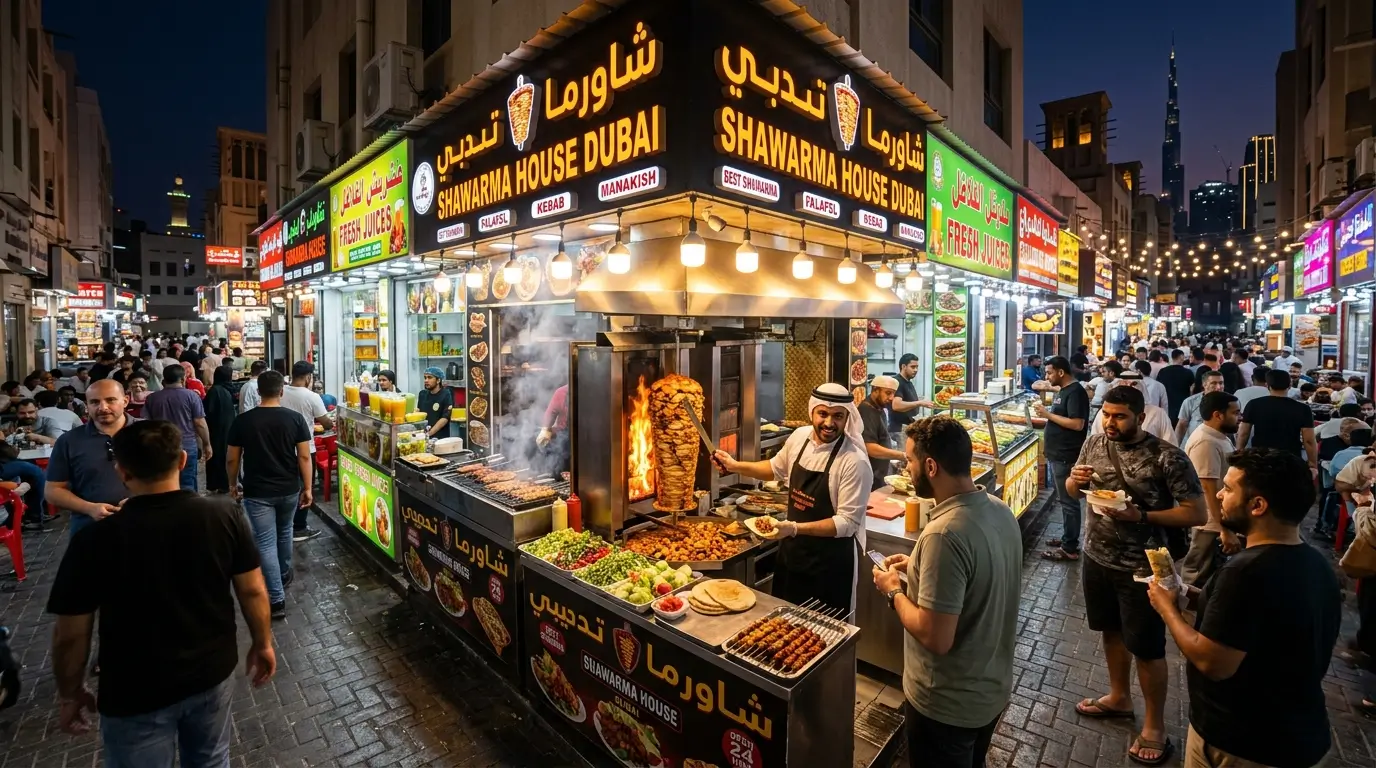
Shawarma is the undisputed king of Dubai street food and the single most consumed food item in the city by volume. A preparation originating in the Levant — Lebanon, Syria, Jordan, and Palestine — it has been so thoroughly adopted by every community in Dubai that it functions as a kind of common currency of hunger. You can find shawarma stands on almost every street corner, each with its own special marinade and sauce recipe developed over years.The Dubai shawarma consists of marinated chicken or meat — sometimes lamb, sometimes a blend — slow-roasted on a vertical spit over gas or wood, sliced to order, and wrapped in warm thin Arabic bread with tahini sauce, garlic paste, pickled vegetables, tomatoes, and sometimes chips. The quality difference between a great Dubai street food shawarma and an average one comes down entirely to two things: the marinade and the freshness of the bread. The best chicken shawarma has been marinating for at least 12 hours in a blend of cumin, cardamom, cinnamon, coriander, and lemon. The bread is baked that morning.
Al Mallah on 2nd December Street in Al Satwa is the single most consistently recommended Dubai street food shawarma spot in the city. Long-term residents describe it as the reference standard against which all other shawarma is measured. The accompanying fresh avocado juice has developed its own following. Allo Beirut on Hessa Street is another celebrated Dubai street food spot recognised consistently by food writers, operating 24 hours and serving shawarma alongside freshly baked saj bread. Prices range from AED 8 to AED 15 per piece.
Manakish — The Best Breakfast Street Food in Dubai
Manakish is the breakfast staple of Dubai’s Lebanese and Syrian communities and one of the most important street food items in Dubai for visitors who want to eat like a local from their first morning in the city. Manakish is a Levantine flatbread baked in a wood-fired or gas oven, topped with za’atar — a blend of wild thyme, sesame, sumac, and salt mixed with olive oil — cheese, or minced meat. It is eaten fresh from the oven, folded in half, and consumed standing or wrapped in paper.The za’atar version is the most classic and the most important to try first. The herb-and-oil combination creates a flavour that is simultaneously earthy, slightly sour from the sumac, and richly savoury from the sesame. Fresh manakish bakeries are concentrated in Al Karama, Al Satwa, and Bur Dubai and open from early morning, filling the streets with the smell of baking bread and dried herbs. Zaroob, a Levant street food restaurant with multiple locations across Dubai, has made manakish accessible to a wider audience while maintaining quality. Mama’esh, a Palestinian restaurant with several branches, serves manakish loaded with melted cheese and Palestinian hummus. Prices start from AED 5 to AED 15 depending on topping and size.
Luqaimat — Traditional Emirati Street Dessert
Luqaimat are the most authentic Dubai street food dessert and one of the few items in this guide that is specifically Emirati rather than adopted from another cuisine tradition. These small golden dumplings are made from a batter of flour, yeast, saffron, and cardamom, deep-fried until crispy on the outside and pillowy within, then drizzled immediately with dark date syrup or honey and dusted with sesame seeds. They are the signature sweet of Ramadan evenings, of family gatherings, of the moments after prayer when something warm and sweet is needed.Luqaimat must be eaten fresh and hot — within minutes of frying — for the full experience. The hot crispy exterior gives way to a soft, slightly chewy interior, and the depth of sweetness in the date syrup version is unlike any other sweet preparation in the city. The cart outside the Dubai Museum in Al Fahidi is the most consistently recommended source among long-term Dubai residents who know their street food. Luqaimat carts operate throughout Old Dubai neighbourhoods, Global Village during its season, and at traditional markets across the city. Prices run AED 10 to AED 20 per portion.
Karak Chai — The Soul of Dubai Street Food
Karak chai is the most socially important Dubai street food drink and one that most travel guides cover superficially. This is not a simple tea — it is a specific preparation of black tea simmered with milk, sugar, cardamom, saffron, and sometimes ginger and cloves until it becomes intensely flavoured, deeply orange, and sweetly spiced. A cup of karak at a roadside stall costs almost nothing and is an essential part of the best cheap street food experience in the city — served to construction workers before dawn, to office workers at 11am, to families after evening prayers.
The Indian-origin tea preparation has become so embedded in UAE culture that it is now considered a Dubai street food institution in its own right. The best karak comes from the small roadside chai stalls and Indian cafes of Deira, Al Karama, and Bur Dubai — tiny establishments with a few plastic chairs outside that exist primarily to serve karak and light snacks. The stalls around the Textile Souk in Bur Dubai and the Al Rigga area in Deira are the most celebrated karak zones. Prices range from AED 2 to AED 5 per cup, making karak the most affordable Dubai street food item in this entire guide.
Falafel — Best Vegetarian Dubai Street Food
Falafel is the best vegetarian Dubai street food option and one that reaches exceptional quality in this city thanks to the large Lebanese and Syrian communities that have brought their home country falafel traditions with them. Dubai falafel is typically Lebanese-style — crispy, herb-filled balls of ground chickpeas or fava beans served with tahini sauce, fresh salad, and warm flatbread. The best versions have a bright green interior from fresh parsley and coriander, a shatteringly crispy exterior achieved by frying at exactly the right temperature, and a creamy, herb-forward flavour that makes it one of the most satisfying vegetarian preparations in any street food tradition.
Falafel wraps are found throughout Deira, Bur Dubai, and Al Karama at prices of AED 5 to AED 12. The Lebanese and Syrian restaurants of these neighbourhoods make fresh falafel throughout the day and serve it wrapped or plated with hummus, tabbouleh, and pickled vegetables. For vegetarian visitors who want to experience Dubai street food without meat, falafel combined with manakish and fresh juice constitutes a genuinely excellent and culturally authentic meal for under AED 30.
Regag — Emirati Street Bread
Regag is a paper-thin Emirati flatbread and one of the most visually distinctive Dubai street food preparations. Vendors cook it on a large round iron griddle with extraordinary speed — the batter is flour, water, and salt, spread across the hot surface in a single fluid movement, and within seconds it is done. The result is a translucent, slightly crispy flatbread served with eggs, kiri cheese, honey, or date syrup. It is one of the authentic street food items in Dubai whose entire character is defined by its thinness and the contrast with whatever filling is placed on top. Traditional Emirati food markets and heritage area stalls are the best places to find fresh regag in Dubai.
Best Indian Dubai Street Food
The Indian expatriate community forms the largest single nationality group in Dubai, and their culinary traditions represent one of the richest and most varied elements of the street food scene in Dubai. Indian Dubai street food covers a wider range of regional traditions than most visitors expect — it is not a single cuisine but dozens of regional sub-cuisines coexisting in the same city.
Biryani — The Greatest Rice Dubai Street Food
Biryani is the most important Indian Dubai street food item and one that reaches exceptional quality in the Meena Bazaar area of Bur Dubai and the budget restaurants of Al Karama. The Dubai biryani tradition draws from multiple Indian regional styles — Hyderabadi dum biryani, Lucknawi biryani, Kerala-style malabar biryani, and Sindhi biryani from Pakistan all have dedicated communities who maintain their authentic preparation methods. The aromatic layers of fragrant rice, marinated meat, and whole spices cooked together create a street food experience in the city that is complete, satisfying, and available for AED 18 to AED 30 per generous portion from the best budget spots in Meena Bazaar.
Pani Puri and Chaat — Indian Dubai Street Food Snacks
Pani Puri — small crispy spheres filled with spiced chickpeas and potatoes, then filled with flavoured water and consumed in a single bite — is one of the most interactive and entertaining street food experience in the citys available. The explosion of flavour when the puri breaks and the spiced water hits the palate is unlike anything else in the Dubai street food spectrum. Indian chaat more broadly — the category of sweet, sour, spicy snack foods that includes bhel puri, papdi chaat, and dahi puri — is available from street-facing snack stalls in Al Karama and Bur Dubai at AED 10 to AED 25. These are quintessential Indian street food items in Dubai that connect the city’s enormous Indian population to their home food culture.
Samosas — Dubai’s Most Universal Snack
Samosas are perhaps the most universally available Dubai street food snack, found equally in Indian, Pakistani, and Gulf Arabic culinary traditions. The crispy triangular pastry shell filled with spiced potatoes and peas or minced meat is available at street stalls, Indian restaurants, and bakers throughout the city. The best samosas come from the dedicated snack stalls of Meena Bazaar and the Indian sweet shops of Al Karama, where they are fried to order and cost AED 2 to AED 5 each. They are the perfect Dubai street food accompaniment to a cup of karak and constitute one of the most affordable and satisfying snacking combinations the city offers.
Best Areas for Dubai Street Food
Al Dhiyafah Road, Al Satwa — Shawarma Central
Al Dhiyafah Road in Al Satwa is the most celebrated street for shawarma Dubai street food and the one road that every serious Dubai food lover knows by reputation. Multiple competing shawarma restaurants line this single street, and the quality competition between them has elevated the standard of shawarma available here above almost anywhere else in the city. Al Mallah anchors the street food scene here and has been operating for decades. The evening atmosphere from 7pm onwards, when the restaurants fill and the smell of roasting meat drifts down the road, is one of the most genuinely atmospheric street food experience in the citys available in the city.
Deira Old Souk Area — Historic Dubai Street Food Heart
The area around the Gold Souk, Spice Souk, and Textile Souk in Deira represents the historic heart of street food culture in the city. The narrow lanes and covered souk streets here have been feeding traders, workers, and residents since before Dubai became a modern city. The range of Dubai street food here covers Iranian kebabs, Pakistani biryani, Indian snacks, Gulf Arabic grills, and Filipino dishes within walking distance of each other.
Al Rigga Street in Deira is another standout Dubai street food corridor. This busy street transforms in the evening as food vendors set up and restaurants open their shuttered fronts. The variety here is genuinely astonishing — you can start with Arabic mezze, move to Indian main courses, and finish with Filipino desserts, all within 200 metres. The best Dubai street food in Deira operates late into the night, serving the crowds that come specifically from other parts of the city for the food.
Meena Bazaar, Bur Dubai — Indian Food Heaven
The streets around Meena Bazaar in Bur Dubai constitute the most concentrated Indian Dubai street food destination in the city. The narrow lanes of this Indian trading district are lined with restaurants, sweet shops, juice bars, and snack stalls serving the full range of South Asian street food at prices that make everywhere else look expensive. Thali meals from AED 15, biryani from AED 18, fresh samosas for AED 2, sugarcane juice for AED 5, and mithai sweets by weight from AED 10 — this is Dubai street food at its most authentic, most affordable, and most densely concentrated.
Al Karama — Dubai’s Budget Food District
Al Karama is the undisputed champion of affordable Dubai street food and sit-down budget dining. The neighbourhood between Karama Centre and Al Karama Metro Station contains the highest density of street-level budget food in the city, dominated by South Asian cuisine but extending to Filipino, Indonesian, and Sri Lankan. Karak stalls, falafel shops, manakish bakeries, and budget Indian restaurants operate side by side. The Al Karama Metro Station on the Green Line makes it easily accessible from anywhere in Dubai, making it the most practical Dubai street food destination for visitors staying in other parts of the city.
Global Village — Seasonal Street Food Paradise
Global Village runs from October to April each year and is one of the most unique Dubai street food environments in the world. The venue spans over 17.5 million square feet and brings together food pavilions from over 90 countries, representing an unprecedented concentration of international Dubai street food in one location. The 200+ food kiosks range from Emirati traditional sweets and Filipino street food to Turkish gözleme, Indian chaat, and the viral Dubai Chocolate that became a global phenomenon. For visitors who want to experience the maximum variety of Dubai street food in a single evening, Global Village during its October to April season is the answer.
Dubai Chocolate — The Viral Dubai Street Food Sensation
No Dubai street food guide for 2026 would be complete without addressing the Dubai Chocolate phenomenon, which began as a local food trend in 2024 and became one of the most viral food products in the world through 2025 and into 2026. The Dubai Chocolate bar uses a filling of pistachio cream and butter-fried kunafa pastry — crispy, chewy, and intensely pistachio-flavoured — encased in smooth chocolate. The textural contrast between the crispy kunafa and the creamy pistachio filling is what makes it so immediately compelling to anyone who tries it.
The original inspiration comes from knafeh, the traditional Arabic dessert of shredded pastry and cheese soaked in rose-flavoured syrup. The Dubai Chocolate takes the texture of kunafa pastry and the flavour combination of pistachio and sweetness and applies it to a chocolate delivery format that is both familiar and completely novel. By January 2026, Dubai Duty Free alone was selling 83 tonnes of Dubai Chocolate per month — AED 36 million in a single month from airport purchases alone. This is the Dubai street food invention that put the city’s food scene on the global viral map and continues to draw food tourists who want to try the original at source.The best versions of Dubai Chocolate and the knafeh desserts that inspired it are found at Arabic sweets shops throughout Deira and Bur Dubai, at Global Village stalls during the season, and at specialty dessert shops across Dubai Marina and Downtown that have built their menus around the original concept.
Dubai Street Food Safety and Hygiene
Dubai street food operates under one of the most rigorously enforced food safety regulatory frameworks of any major city in the world. The Dubai Municipality Food Safety Department conducts regular inspections of street food vendors, stalls, and budget restaurants across the city. All food businesses require a valid Dubai Municipality licence that is only issued and renewed following inspection compliance.
The practical result for visitors is that Street food safety in Dubai is genuinely excellent by any international standard. Street food in Deira, Bur Dubai, and Al Karama is not the kind of high-risk informal vending that visitors might associate with street food in other parts of the world. These are licensed businesses operating under municipal regulation. Standard precautions — choosing stalls with high turnover that indicate fresh preparation, selecting places where you can see the food being cooked, and consuming food immediately rather than letting it sit — apply as they would at any street food destination but represent basic good practice rather than a genuine safety concern.
Practical Tips for Eating Dubai Street Food
The best time to eat Dubai street food is in the evenings between 7pm and 10pm when vendors are at their busiest, turnover is highest, and the atmosphere is most lively. The Old Dubai streets of Deira and Bur Dubai are particularly atmospheric during this period, and the combination of the cooler evening temperatures and the full activity of the street food scene makes for genuinely memorable experiences.
Using cash for Dubai street food purchases is practical at traditional street stalls and small vendors where card readers are not always available. Larger budget restaurants accept cards universally. AED 100 in cash is more than enough for an extensive evening of Dubai street food exploration across multiple stops and dishes.Arriving at famous shawarma spots early in the evening rather than late gives you the best meat — the spit roasts throughout the day and is most perfectly cooked in the early evening hours before being refreshed.Following the crowds is reliable guidance for Dubai street food quality. A stall with a queue of residents from the local community has earned that queue through consistent quality over time. A stall with no queue in a busy area is a signal to look elsewhere.
FAQs
What is the most famous street food in Dubai?
Shawarma is the most famous and most consumed Dubai street food. It is available on virtually every street in the city, costs AED 8 to AED 15, and reaches its highest quality on Al Dhiyafah Road in Al Satwa and at dedicated shawarma spots in Deira and Bur Dubai. Luqaimat is the most distinctively Emirati Dubai street food. Manakish is the best breakfast street food in Dubai. Karak chai is the essential Dubai street food drink that accompanies any time of day or night.
Where is the best area for street food in Dubai?
The best areas for Dubai street food are Al Dhiyafah Road in Al Satwa for shawarma, the Meena Bazaar area in Bur Dubai for Indian street food, Deira’s Old Souk lanes for the broadest variety, Al Karama for the most affordable options across South Asian cuisines, and Global Village during October to April for the widest international street food variety in one location.
Is Dubai street food safe to eat?
Yes. Dubai street food operates under strict Dubai Municipality food safety regulation, with all vendors required to hold valid licences issued only following hygiene inspections. Dubai maintains one of the highest food safety enforcement standards of any major city in the world. The practical safety record of Dubai street food is excellent, and food poisoning incidents at licensed street food vendors are rare.
How much does street food cost in Dubai?
Dubai street food is genuinely affordable. A shawarma costs AED 8 to AED 15. Manakish costs AED 5 to AED 15. Karak chai costs AED 2 to AED 5. Luqaimat costs AED 10 to AED 20 per portion. Falafel wraps cost AED 5 to AED 12. A biryani plate from a budget restaurant costs AED 18 to AED 30. A complete Dubai street food evening covering multiple dishes and drinks for one person typically costs AED 40 to AED 80 depending on appetite and variety.
What is Dubai street food like compared to other cities?
Dubai street food is unique because it combines the street food traditions of over 200 nationalities in a single city while maintaining quality standards enforced by municipal regulation. It is more diverse than any single-cuisine street food destination, more affordable than the city’s luxury reputation suggests, and of higher regulated hygiene standards than many comparable street food destinations globally. The combination of Emirati traditional sweets, Lebanese shawarma, Indian biryani, Pakistani karahi, and Filipino seafood all available within walking distance of each other is genuinely unmatched anywhere in the world.
Conclusion
Dubai street food in 2026 tells the story of a city whose true culinary identity is written not in its Michelin stars but in its shawarma spits, its luqaimat fryers, its karak chai stalls, and its biryani pots. The street food scene in Dubai is where the city’s extraordinary diversity expresses itself most honestly — where 200 nationalities meet at the level of hunger and good food and produce something genuinely extraordinary in the process.
The AED 8 shawarma at Al Mallah, the freshly fried luqaimat outside the Dubai Museum, the karak at a Deira roadside chai stall, the biryani from a Meena Bazaar pot — these are the street food experience in the citys that long-term residents return to above almost any other option in the city regardless of budget. They are the reason that Dubai street food, understood properly, is one of the most rewarding culinary experiences available anywhere in the world.